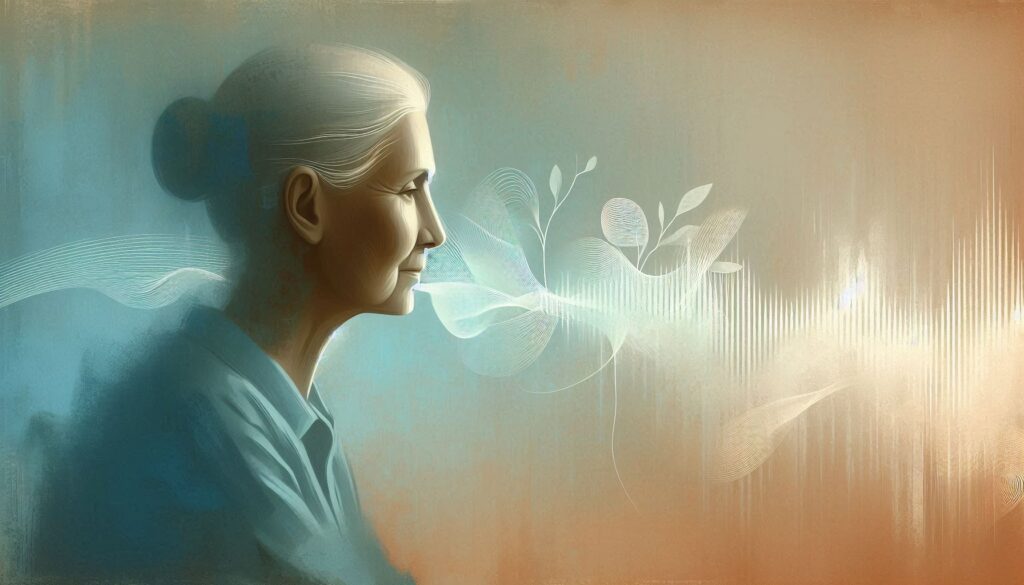
When Words Fail, Music Remembers: How a 90s Playlist Reached My Mother
The quiet of my mother’s room was often punctuated by fragments of murmured words—remnants of thoughts and memories surfacing unexpectedly, like bubbles rising from the depths of a forgotten pond.
One afternoon, I heard something different. Not the usual anxious whispers about stolen clothes or phantom visitors. This was… a melody. A series of words that seemed to follow a rhythm.
I stopped what I was doing and listened carefully.
“…dancing in the moonlight… everybody’s feeling warm and bright…”
Wait. Was she singing?
I moved closer, sitting on the edge of her bed. Her eyes were closed, her lips moving almost imperceptibly, forming words I hadn’t heard her speak coherently in weeks.
It took me a moment to recognize the song—a popular hit from the 90s, one that had probably played on every radio station when I was young. But more importantly: she remembered every word.
This was the woman who couldn’t tell me what she’d eaten for breakfast. Who sometimes forgot my name. Who lived in a fog of confusion, hallucinations, and Parkinson’s tremors.
But give her a song from 30 years ago? She became whole again.
The Science Behind Music and Dementia Memory
Before I tell you what happened next, let me explain why this matters.
Research shows that musical memory is stored differently than other types of memory in the brain. Even when dementia destroys the hippocampus (the area responsible for forming new memories), the areas that process music—particularly emotional and procedural memory regions—often remain intact much longer.
This is why someone with advanced Alzheimer’s might not recognize their own child but can sing every verse of their wedding song.
Why Music Works When Nothing Else Does:
1. Deep Encoding Music from our youth gets encoded during crucial developmental years. These memories are more deeply embedded and resilient to deterioration.
2. Emotional Connection Songs trigger the limbic system—the emotional center of the brain. Emotions are powerful memory anchors.
3. Multiple Brain Pathways Music activates nearly every region of the brain simultaneously: auditory, motor, emotional, and memory centers. This redundancy means even damaged pathways have backup routes.
4. Rhythm and Repetition The brain loves patterns. Song structure (verse, chorus, verse) creates predictable patterns that are easier to recall than random information.
For my mother, songs from the 60s through the 90s weren’t just music. They were time capsules—portals to periods when her brain was healthy, her body was strong, and her world made sense.
How I Discovered Music Was the Key
After that afternoon of hearing her hum a 90s hit, I became determined to unlock more of these musical memories.
I spent hours compiling playlists on my phone:
- 1960s Romanian folk songs (from her childhood)
- 1970s pop hits (from her teenage years)
- 1980s ballads (from her young adult life)
- 1990s dance songs (when she was raising us kids)
I organized them by decade because I noticed she responded differently depending on her mood. When agitated, older songs calmed her. When withdrawn, upbeat 90s tracks energized her.
The First Time I Played the Playlist
It was a restless afternoon. She’d been fixated on “the woman who steals clothes” for over an hour, accusing the invisible intruder of taking her dresses. I’d shown her the closet three times. Nothing helped.
Exhausted and desperate, I pulled out my phone and quietly pressed play on the 70s playlist.
The first notes of a familiar Romanian love song filled the room.
She stopped mid-sentence.
Her head turned toward the phone, eyes widening slightly. Her lips began to move, silently at first, then with growing confidence.
Within seconds, she was humming along. Then softly singing. Then—amazingly—singing with full voice, every word perfect, every note in tune.
The “stolen clothes” were forgotten. The invisible woman vanished. For those three minutes, my mother was back.
The Songs She Never Forgot
Over the following weeks, I discovered there were certain songs whose lyrics seemed untouchable by dementia—locked in a corner of her mind that the disease couldn’t reach.
“Cine Iubește și Lasă” (Romanian Classic)
A melancholic ballad about lost love. She knew every verse, every inflection. When it played, she’d close her eyes and sway gently, her trembling hands stilled by the music.
“Dancing in the Moonlight” (1970s Hit)
The song I first heard her humming. It became her “happy song.” Whenever she was anxious, this one could sometimes pull her back to calm.
“O, Ce Veste Minunată” (Christmas Carol)
Even in July, this one brought her peace. Her faith had always been strong, and religious songs seemed to tap into the deepest reservoirs of her memory.
Various 90s Dance Hits
Songs I barely remembered from my own childhood. But she knew them all. She’d tap her fingers (when the tremors allowed) and smile—a real, genuine smile that broke through the confusion.
The “Concert” That Never Happened (But Did)
A few days after discovering the power of music, something extraordinary happened.
I’d been playing songs for about an hour while she rested. She seemed content, occasionally humming along, her eyes closed in peaceful concentration.
When the music stopped, she opened her eyes and looked at me with the softest, most contented smile.
“Thank you, my dear,” she said gently. “Thank you for taking me to the concert. It was wonderful.”
I froze.
We hadn’t left the house. We were sitting in her bedroom, just the two of us and my phone.
But in her mind? She’d just attended a live concert.
The music had transported her so completely that her brain filled in the rest—the venue, the crowd, the experience of being out in the world again, doing something she loved.
“You’re welcome, Mama,” I said, my voice catching. “I’m so glad you enjoyed it.”
She squeezed my hand. “It’s been so long since I’ve been to a concert. This was special.”
And you know what? It was special. The concert may have only existed in her mind, but the joy it brought her was absolutely real.
How Music Changed Our Daily Caregiving Routine
After seeing the profound impact of music, I integrated it into our everyday life:
Morning Routine: Gentle 60s Folk Songs
Waking up was often disorienting for her. Soft, familiar songs from her childhood helped ease the transition from sleep to wakefulness.
Afternoon Agitation: Upbeat 80s/90s Hits
When hallucinations intensified or she became fixated on phantom problems, lively music could sometimes break the cycle.
Evening Wind-Down: Religious Hymns and Lullabies
As the sun set (when “sundowning” often worsened symptoms), peaceful spiritual songs helped her relax into sleep.
During Meals: Background Instrumentals
Music without lyrics helped her focus on eating without overstimulation.
The Unexpected Benefits of Music Therapy
Beyond the obvious joy it brought her, I noticed music had other powerful effects:
1. Reduced Medication Needs
On days when we used music therapy consistently, she needed less anti-anxiety medication. The music itself became medicine.
2. Better Physical Coordination
The rhythm helped with her Parkinson’s motor symptoms. She’d sway or tap fingers in time—movements that were more controlled than her usual tremors.
3. Improved Communication
After music, she was more verbal and coherent. The songs seemed to “warm up” the language centers of her brain.
4. Connection Between Us
When we listened together, holding hands, it created a shared experience—a bridge between her reality and mine.
5. Moments of Lucidity
Sometimes, right after a particularly meaningful song, she’d have brief windows of clarity where she’d recognize me fully, talk about real memories, and seem almost like her old self.
The Bittersweet Reality: Music Can’t Stop Dementia
Here’s the hard truth: Music didn’t cure her.
The hallucinations still came. The confusion still dominated most days. The Parkinson’s still progressed.
But music gave us something invaluable: moments of connection in a disease that steals connection.
There were afternoons when, after singing along to an entire song perfectly, she’d turn to me and ask, “Who are you?”
The contrast was devastating. How could she remember every word to a song from 1975 but not recognize her own son?
That’s the cruel paradox of dementia. Musical memory can remain pristine while everything else crumbles.
How to Use Music Therapy with Your Loved One
If you’re caring for someone with dementia, here’s how to harness the power of music:
Step 1: Identify Their Musical Era
Ask:
- What decade were they 15-25 years old? (Peak musical memory formation)
- What songs did they sing to you as a child?
- What music played at their wedding?
- What was popular when they were in their 20s-30s?
Step 2: Build Personalized Playlists
Create separate playlists for:
- Morning/energizing songs
- Calming/evening songs
- Religious/spiritual music (if applicable)
- Language-specific songs (if they’re bilingual)
Platforms: Spotify, YouTube Music, Apple Music all work. I used YouTube because I could find older Romanian songs more easily.
Step 3: Observe and Adjust
Watch for:
- Which songs make them smile vs. agitated
- Optimal volume (not too loud, which can overwhelm)
- Best time of day for music
- Whether they prefer singing along or just listening
Step 4: Make It Interactive
Try:
- Singing together (even if you’re off-key)
- Holding hands while listening
- Gentle swaying or dancing (if mobility allows)
- Encouraging them to tap rhythm with hands or feet
Step 5: Use Music as Redirection
When they’re distressed:
- Put on a familiar song instead of arguing about hallucinations
- Use music to transition between activities
- Play calming music during challenging tasks (bathing, medication)
Music Therapy Resources for Caregivers
Free Tools:
- Music & Memory: Non-profit providing training and playlists for dementia care
- Spotify Dementia Playlists: Search “dementia music therapy” for pre-made playlists
- YouTube “Songs from [Decade]”: Endless era-specific compilations
Apps:
- Music & Memory App: Personalized playlist tool
- Dementia Music: Curated therapeutic music selections
- SingFit: Music therapy app with memory-stimulating songs
Professional Support:
- Board-Certified Music Therapists: Find through American Music Therapy Association
- Memory Cafes: Community programs using music for dementia patients
The Last “Concert”
A few weeks ago, I played her favorite 70s ballad—the one about lost love that she never forgot.
She sang every word, her voice trembling but true. When it ended, she opened her eyes, tears streaming down her face.
“That was beautiful,” she whispered.
“You sang it beautifully, Mama,” I said.
She looked at me—really looked at me—and for just a moment, I saw full recognition in her eyes.
“Thank you for the music,” she said. “It helps me remember who I am.”
And there it was. The truth of why music matters so much.
When dementia steals identity, music holds a mirror to the self that remains.
For Caregivers: Music Is Your Secret Weapon
If you take nothing else from this article, take this:
When words fail, when logic doesn’t work, when you’ve tried everything else—try music.
You might not get the miracle of full recognition. You might not reverse the disease. But you will get something precious:
Moments. Connection. Joy.
And in the exhausting, heartbreaking journey of dementia caregiving, those moments are everything.
The Playlist Still Plays
Every day, I press play. Some days she sings. Some days she just listens. Some days she asks me to turn it off.
But every time a familiar song reaches her ears, I see a flicker—a glimpse of the woman she was, still alive somewhere beneath the fog.
The concert in her mind continues. And as long as she can hear the music, she’s never completely lost.
Continue Our Journey
Read the complete story: Whispers From the Attic documents our full journey through Parkinson’s dementia, including how music became our lifeline when words disappeared. Available on Amazon
Subscribe for weekly caregiving stories and practical tips delivered to your inbox.
Does music reach your loved one with dementia? What songs bring them back? Share your musical memories in the comments below.
Cristian cares for his mother with Stage 4 Parkinson’s disease and dementia in Romania. Music from the 60s-90s remains his most powerful caregiving tool—a bridge to the woman who raised him, still singing somewhere beneath the disease. Listen to his mother’s favorite songs and follow their journey at HopesForMom.com.